Despite lending his name to countless species and places, Alexander von Humboldt, who conceived nature’s theory of interconnectedness, seems all but forgotten. Journeying through American landscapes and infrastructure bearing his name, filmmaker Anthony G. Svatek contemplates his legacy and the questions of ecology, technology, extraction, and environmental injustice.
In an interview with Editing Docs, G. Svatek is joined by his co-editor Kaija Siirala as they discuss their documentary feature, Humboldt USA, reflecting on the wilderness in the material, new findings that emerged, and the need to build time off from an edit to keep “freshness” of eyes.
Editor Anne Fabini once talked about “the wilderness in the material” and how it is important not to tame it, so as not to lose its vitality. Could you talk about “the wilderness” in your film and how you ensured you didn’t tame it?
Kaija Siirala: I think the first thing that comes to mind is taking time. When I am editing, there’s always this sense that you don’t want to overcut something too quickly. That first watch-through is about getting acquainted with the wilderness of the material: what is here, what is alive. I’m trying to take it into my body and notice the things that feel alive. You’re letting the material speak to you. Especially when you’re working with human characters, it takes time for them to feel comfortable with the director, with the camera, with the setup. So you’re looking for those moments where something is coming through, or where the tension between performance and someone actually sinking into what they’re doing gets alleviated. If you are afforded the time to actually spend with material, I think it’s important because it can also reveal a lot in terms of what the director thinks is there and what is actually there.
Anthony G. Svatek: For me, this was my first experience working with an editor on a film of mine. I’ve always edited my own work solo, and that was a huge learning curve. My instinct is often to say, “Let’s cut this down, let’s lose this,” especially in expositional or interview-based material. Kaija encouraged us to be very conscientious about that, and not to jump the gun early in the process, because we don’t yet know what’s going to be helpful, and what’s maybe superfluous. The other thing about wilderness that comes to mind is that I wanted to make sure the film had fingerprints, the proverbial fingerprints of the filmmakers and the creative people behind it. I wanted to feel a presence behind the camera, and a presence in the edit. I didn’t want the edges cut off. I wanted things to feel relatable and rough, not super slick and clean and perfect and static, which is very much taming and containing and pruning the wilderness. So we made sure there were a couple of edits in the film that may seem like a mistake, but they convey a feeling or a dynamic that I really wanted to keep.
I remember one at the end of the sheep capture scene. There’s a really long take on the face of one of the sheep after you’ve seen this crazy, violent scene. Then the camera shakes for maybe half a second and swoops away. I really wanted to keep that in there. Our producer said, “Oh, that looks messy,” and I said, “No, we need to keep that.” It gives a sense of humility back to the subject. There’s nothing dominant over what’s being filmed in how it’s being captured. There’s a vulnerability, and I think that’s important.
Speaking of the sheep, the film opens and closes with an almost still image of bighorn sheep, and then we see different representations of sheep on screen, in a casino, and in a mall. It’s a recurring motif. Could you talk about that?
KS: That came very early. I felt very strongly that it should end by moving from the petroglyphs to the bighorn sheep in the Buffalo Zoo.
AGS: We only see the sheep when they’re being captured. Otherwise they’re completely elusive. So what does it mean to get to witness these animals? What are the ways we witness them? How is that image mediated throughout time, from these drawings to the animals held in the Buffalo Zoo?
KS: We had started with the zoo quite early in the process, and then we cut that scene and started in New York with a highly mediated nature shot, the Heart of the Andes painting at a museum. About a month before we locked the edit, I thought we needed to bring the zoo scene back. It doesn’t follow our neat “first location, second location” structure, but I love the idea of starting and finishing there. I think it also speaks back to what Anthony was saying about them watching us versus us watching them. And the scene of the ram and the trailer: when I first watched it, I was so moved by the interaction between Anthony, who was shooting, and the ram. At one point he clicks his tongue and the animal tenses into this extreme state, and you see how afraid it is. Then Anthony moves the camera away, because the ram keeps staring at him. There’s something important in there: We’re looking at you, and you’re looking at us. And there’s something uncomfortable in the gaze that is held. I think it implicates the viewer, and it implicates the filmmakers in an important way.
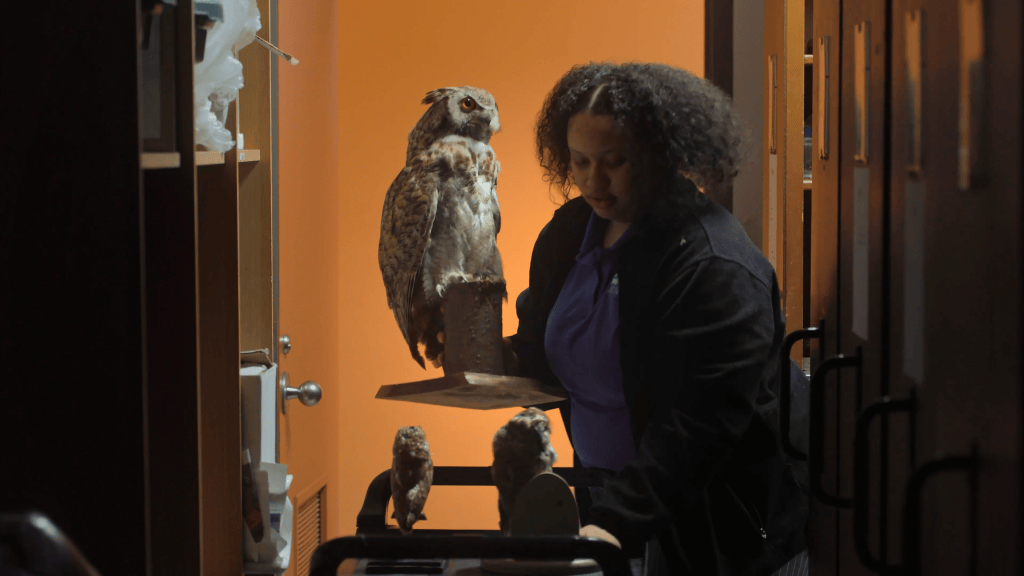
AGS: For me, it was important to convey that what we captured of the sheep is the only time you see them. You never really see them in the wild. You only ever see them in strange, artificial situations as these totally abstracted, de-physicalised beings, whether in the zoo, being airlifted down by helicopter, as taxidermied creatures in a mall, on a casino TV screen, or as dots on a computer screen. Also, on a purely instinctual level, an animal looking at you is very, very powerful. And it’s a trope in documentary filmmaking. When we were at Visions du Réel, there were at least three other films with sheep in them, and sheep staring into the camera. It was such a thing. I talked to the programmers about it, and they said, “Yep, we all notice it.” Every year there’s some kind of theme, and this year it was sheep staring at the camera.
There are pictures of nature in your film. Could you talk about the significance of such representations or mediations of nature?
AGS: I’ve made a number of films about mediations of nature. That comes from my experience of having grown up at the foot of the Austrian Alps, with a very immediate connection to the natural world. Then I moved to New York, and the only time I experienced nature was on screens, in ads, and in photos. It all became a mediated experience, and I started to think about what that does to my perception of nature and how abstract it is. I’ve worked on this topic in a couple of shorts that Kaija and I made together, but it was also the thing on my mind when I was working on this film. I kept thinking: “What are the images of nature that Humboldt would never have seen, that didn’t exist 200 years ago, simply because we didn’t have the technology?” I tried to imagine what it’s like to travel around the world, come back, and have to convey what you saw and experienced only through words, or maybe through some paintings, but no immediate images. You can sketch something, but it’s all mediated through your experience, through your body. And he died right at the cusp of the Industrial Revolution, when technology started to mediate nature.
There are images and experiences of nature that completely changed our visual relationship to the natural world. That’s why I wanted shots of landscapes rushing by really quickly. That’s an image Humboldt didn’t see, as that didn’t exist until about 120 years ago, when high-speed travel was invented. So I kept collecting images of nature that he wouldn’t have seen. I wanted to show Humboldt what nature has become now, and what has happened to his vision of interconnectedness, whether in the natural world or in the technological sense. It peels a copy off the real thing, and that mediation becomes our main way of interacting with nature.
KS: And just to add, I think there’s also a political agenda to that kind of representation. These representations decontextualise the natural world from the world we share. And as humans separate from nature, it allows them to mistreat it or do harm. So what happens when humans see themselves as separate from nature? What happens when they experience nature as a concept rather than as a lived experience?
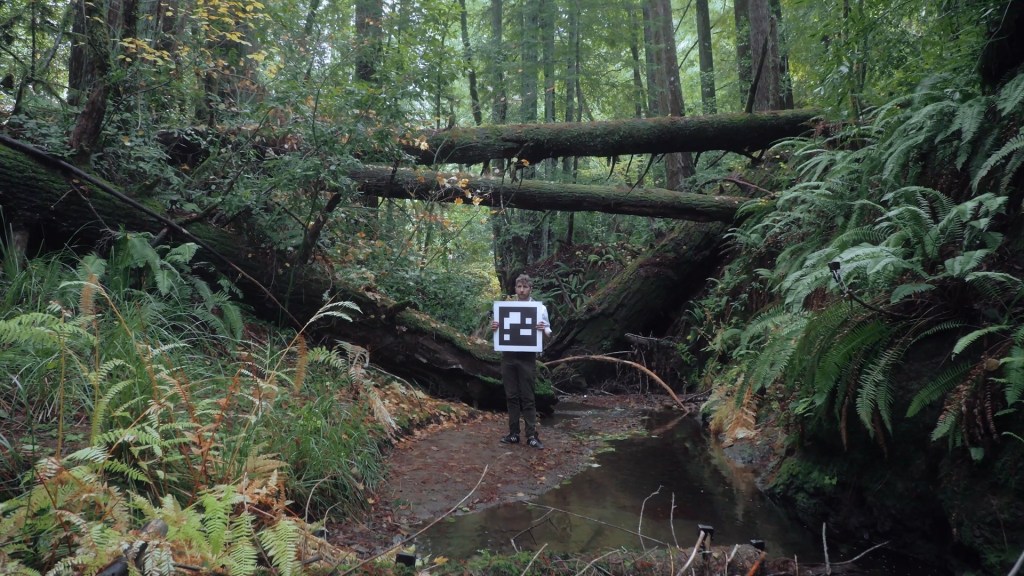
AGS: One thing that struck me in the Redwoods story was that they wanted everybody to be able to experience it. That’s why they’re making three-dimensional renderings, so people can visit the Redwoods without having to be there. But there’s also a disconnection in that. As they’re trying to capture it, they’re in front of these ancient beings, fiddling with their little GoPros so that people will care about the redwoods. There’s something interesting in that. The sense of awe for the natural world is being replaced by a sense of awe, or frustration, with technology.
Humboldt’s pioneering idea of interconnectedness is what in part set you, Anthony, on this journey. How did this idea inform your editing approach and style?
AGS: I think everything’s interconnectedness is one of the broadest statements you could possibly make and make a film about. How do you make that interesting and unique? That was a huge challenge. At the beginning, the three distinct storylines and the voiceover throw you in without making clear how things relate to each other. As the themes grow more parallel and begin speaking to one another, small rhymes emerge in the edits, where a similar feeling is matched with a shot in the next scene. It became very clear that I wanted people to experience the beginning of the film in separate chunks that they had to keep track of. Over the course of the film, those parts get closer and closer and begin to melt into each other, until at some point you don’t know where you are. And there’s that dance sequence that meshes everything together, and it all collapses. Carrying that concept of interconnectedness into a formal process for the film was difficult, but I think Kaija can probably speak to how that worked.
KS: When I’m working on a film, I always think about what form this needs to take to serve the story, not in a didactic sense but in a way that allows the form to reveal something and undergird its themes. Luckily, one of the ways I work is very pattern-based, so we wanted to find dynamic ways to move between the three different locations, whether visually, thematically, or one idea building on the next. One of the things we did really early on was thematic string-outs. A lot of this film was built in scenes, but Anthony and Sean [Hanley], the other cinematographer, both have beautiful eyes, so we had all this stunning visual material to work with. We strung it out to see it regardless of location. That was one of the first things we did when we worked one-on-one together. I’m blanking on all of our weird string-outs at the moment, but there was green rush, psychedelia, mediated nature references to Humboldt. We grouped the material in different ways so that we could see it differently, so we weren’t just thinking “here’s Buffalo, NY, here’s California, here’s Nevada.” And we started seeing the patterns in the footage. I think that revealed things to us too. I imagine for Anthony, there were even things he didn’t necessarily intend, or maybe he did, but there were new findings as were looking at the material in a different way.
Structurally, the concern is always: Is the audience going to be constantly confused as to where we are? The way we landed on the structure was very much by consciously keeping things separate at first. I thought of it as a tightening spiral that would come together, so that by the end you’re not sitting there going, “Where am I?” For me, it doesn’t really matter. The propulsion and the themes of the film take over, and you’re less tracking who this is and where we are. Hopefully we do a good enough job at the beginning to ground the audience so they keep watching.
You mentioned new findings. Could you talk about the ones that emerged in the edit?
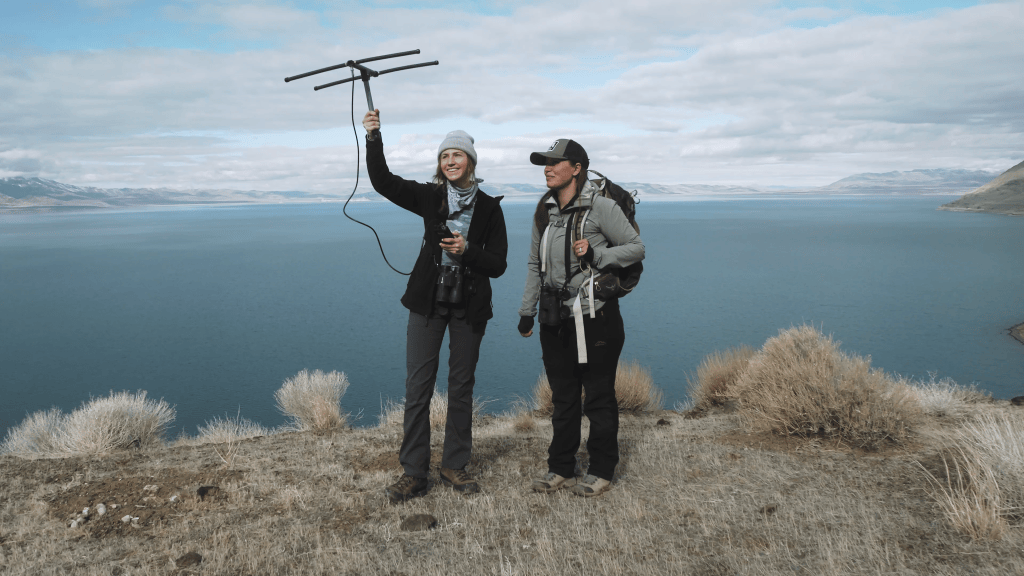
AGS: One of them was the California storyline with our two researchers who are scanning the redwoods. That was an incredibly challenging shoot. It was difficult to navigate their dynamics while being there with them for some days alone. I didn’t look at that footage or my dailies for a while. I couldn’t do it because I thought the seriousness of the topic was ruined by their bickering, their weird dynamics, and their strange friendship stuff. Then, on the very first or second day that we sat down together, Kaija, who had watched everything, said, “Just trust me. We’ll watch it together. Maybe it’ll surprise you.” Watching it with Kaija, with another pair of eyes and that kind of sharpness, made the humour and lightness really obvious to me. It became such an important part of the film, and I didn’t see it until we started working together. There was a lot of warmth, humour, and absurdity, that we could use as a tool to draw viewers in. I’m really glad about that decision. For a while we wondered: Is this a cold, removed, intellectual film, or can it be more accessible, relatable, and inviting? The humour, specifically in the California storyline but everywhere else too, became an invitation, like holding out our hand to the audience, saying: “It’s OK if you don’t understand everything; it’s OK to laugh and bring your own humanity to the film.
The narrator’s voice guides us on this journey, and it’s mostly present while we’re on the road between spaces. Could you talk about your choice to shape the film in such an epistolary form, with the narrator addressing Alexander von Humboldt in the second-person singular?
KS: I remember one of the first things I asked on our first editing retreat was, “How do you want Humboldt to be in this film?” There were things Anthony wanted people to understand, and I said, “If that’s the case, then we have to find another way to bring him in, because it’s not in the observed material or the interviews.” And I do think that for a long time Anthony was resistant to bringing himself in a more personal way. There was a feeling of wanting the film to feel more intellectual, or a bit more removed. But I think we both gravitated toward the humanity of the characters.
AGS: Once we realised this film had more warmth and heart than I originally thought it would, I decided that the voiceover needed to mirror that tone, temperature, and colour. Then we fully leaned into it through many iterations, drafts, and trials. Kaija really helped to usher it in and shape the narrative, the tone, and the sort of love letter to Humboldt. She’s a co-writer on the film, and on the voiceover as well. It was the very last piece to fall into place, and it was a delicate balance between how much exposition the voiceover has to carry versus how much it offers of my own perspective.
KS: We had a screening of our work-in-progress of about 30 minutes at MoMI in March, and it was still the version with the removed voiceover. More questions came up around it, like “Who is this person?” And it was actually Sean [Hanley] who said, “Anthony, when you first told me about this project, you talked about being in love with Humboldt, and that really drew me in.” Then I started thinking, what does it mean to be in love with a ghost? We started thinking about the arc of a crush as a thread we could use: that first blush of “Oh my God, you’re incredible,” and then you see the complexities of who the person really is. It was really important to Anthony not to totally valorise Humboldt, but also not to flatten him. That’s one thing we were trying to do with the film in and of itself: “Yes, he is this and that, and we can hold these complexities at the same time.” So when we started thinking of it as, “Oh, these letters could take the arc of a crush,” that gave us a whole new structural thing to hang the film on. Again, form and content speaking to each other made the voiceover feel integral to the film instead of standing separate from it. There was a point, very late in the game, in May, where we took the voiceover out. We said, “OK, what does it mean not to have the voiceover in there?” And it didn’t work. That’s another thing about digital, non-destructive editing: You can try these crazy things two months before you lock like taking this whole thread out and asking what the film is doing without it. Taking things out reveals what they’re doing in the film, and that can help you hone them.
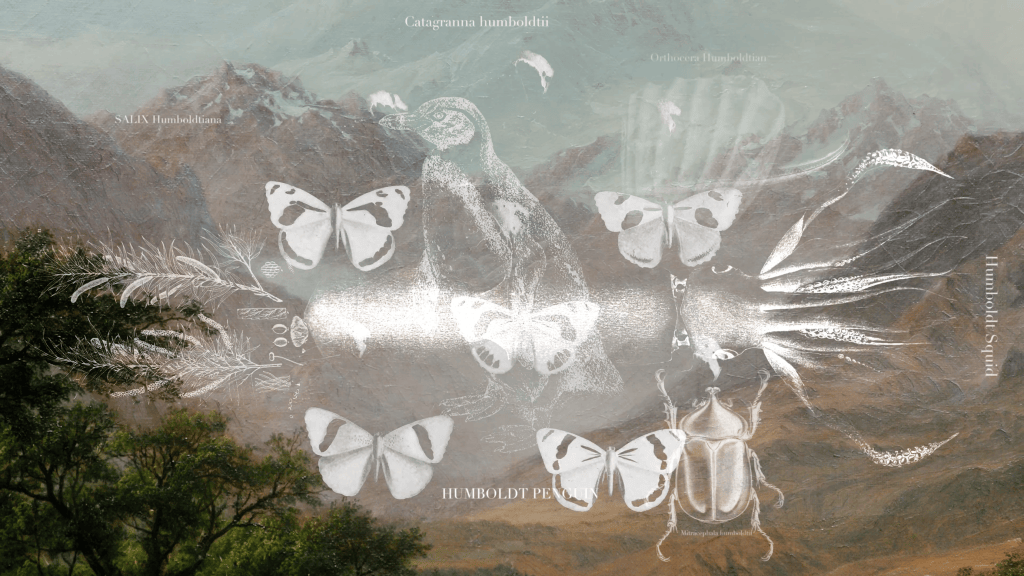
Let’s talk about archival materials and the layering of visual elements within single frames.
AGS: That was another thing at this feedback screening. People were really into the archival material as a formal element, but wanted much more of it, and also more intentional. We were trying to be very deliberate about how much to use, and what to use in particular. I would say the mediated nature imagery is archival material in and of itself. We just capture it in an observed scene, almost, as opposed to using the original materials.
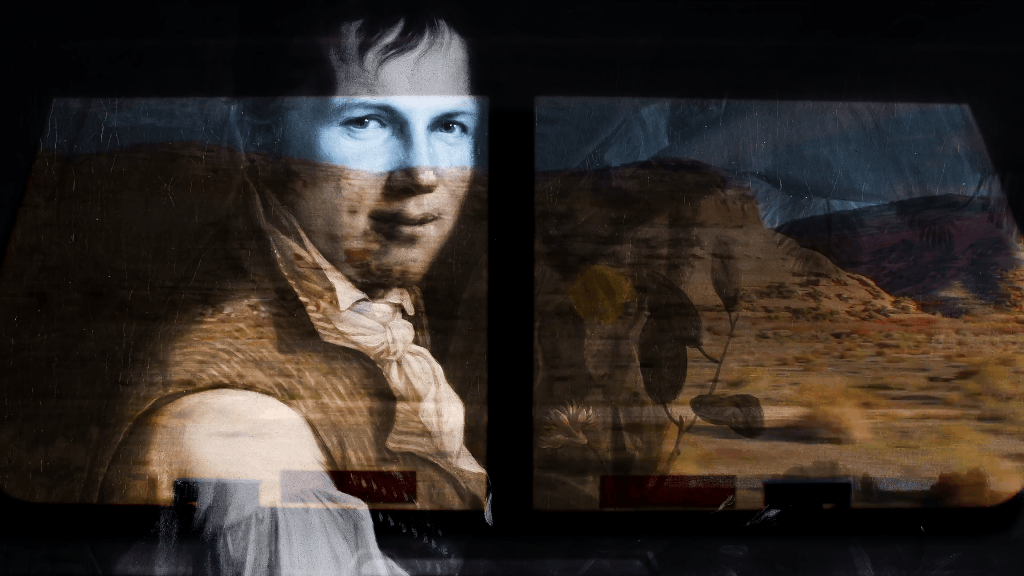
I’ve worked with Lynne Sachs a lot and have edited her films, and I really got into semi-transparent layering and playing with opacity levels. Both Kaija and I also have a collage practice, a 2D collaging with materials, and we wanted to bring that sensibility and tactility in. Archival material allows for that because it’s such a different formal container. I also love transparency. Because it’s layered on top, but still embedded in a shot and in a scene, instead of the material being right in front of your face. You’re able to integrate the context of, let’s say, what Humboldt Parkway was when it was a park, before it was a highway, which is this idyllic scene against the harsh, grey concrete infrastructure that pollutes everything. I wanted those to melt into each other and create a kind of tension. That’s the formal reasoning for how we used it.
KS: I’ll just briefly say the obvious thing, which is that it’s another way of layering time and creating a tension between past, present, and imagined future, which I think was appropriate for this film. I think Anthony did really beautiful work. I love the opening sequence with all the different species, places, and things named after Humboldt. You get the idea of the morass of names in a quick, digestible way. You don’t need to take it all in, but the idea is: “Oh, there’s a lot.”
Kaija, you also did sound design for this film, which is probably a whole new conversation, but could you talk about the guiding principles that shaped your process?
KS: I think of sound as a kind of superpower because it can do a lot to fix things. You can layer multiple sounds and evoke tension across the past, present, and future, which I really love. We did that a bit in the Buffalo scene, when we brought in TV and radio media sound clips that we could layer to create some of the exposition we didn’t have.
In terms of the design itself, what I’m trying to do is take sounds that exist in an environment and make them into musical pieces. I’m interested in that boundary between sound and music. We worked with an amazing composer, Celia Hollander, whose approach is similar, but she comes at it from a more musical standpoint. I also always think of developing distinct palettes. In a film like this, we’ve got three different locations, so what does each one sound like? How are they different? I did a bunch of sound recording of the highway in Buffalo, with contact mics, and the sound of the cars going by was very ghostly to me, so we pushed some of those sounds. And in conversation with Anthony, for example, about the sheep catcher, one of the first things he said was that it was very quiet. Everybody was trying to be very quiet so that the sheep weren’t made more anxious by the noise and activity. But then we’ve got these huge helicopters coming in, which are very loud, so we played with these contrasting sounds in that scene. So for each location, we would develop a palette that was present, and then mess with it, for lack of a better word. Playing with that mediation of natural sounds.
I must also add that usually you do sound design after a film is locked, but this time we were working on the sound as we went, as an integral part of the storytelling
And a final question: You’ve mentioned, Anthony, that you edit your own films. How do you keep freshness when engaging with the material when you’re so deep in it?
AGS: I think that freshness developed out of collaboration with Kaija. She brought in a separate perspective, one untainted by the experience of shooting the film. It was just, “OK, what is actually in the frame?” That helped me look at it from a distance again. Not from a cold distance, more from a different perspective. I wouldn’t say I removed myself from the material. It was more like shifting over.
And what about other projects?
AGS: I went to film school and learned to edit on a Steenbeck, which is a very physical experience. You have to be super intentional about what edits you make, and if you mess up, you have to live with it. You really have to be accountable to your decisions. I think it’s important to keep in mind that the origins of assembling and editing are physical, and there’s a lot of opportunity, chance, and serendipity when you keep that spirit of “let’s just throw this together into a timeline” and allow yourself to be a little messy and accidental. But I haven’t had to create distance or get a different point of view on the other films I’ve made, because they were shorts. It’s much harder to lose perspective in a short film than in a feature just because there are a lot more different puzzle pieces in a longer film.
KS: I think one thing I’ve learned over time is that building time off from your edit into the editing process and schedule is really, really important. That’s maybe obvious, but it’s not just directors who lose perspective. You can be so close to an edit, then take a couple of weeks off, return to it, and see it with a whole new set of eyes. You’re not always afforded the luxury of time as distance, but another editor taught me that if you can build it in, you should, because we get caught up in the machine of “the festival deadline’s coming up,” and you end up working to what are, in some ways, completely fabricated deadlines. Letting the film breathe and returning to it is so important. So much of editing happens not in front of the computer.
AGS: I personally had so much fun working on this together, to the point when another project came along, I had to snag Kaija again because I couldn’t bear not working together and talking every single day. You become really close, and you have to make sure you’re not burdening the other person with your insecurities. That’s a dance, and I feel extremely fortunate that we got to dance it together.
KS: Collaborative editing is such an amazing way to hold a project. I’ve had the privilege of doing that on a few features now, and I really love that way of working, because editing can be so solitary. It’s a crazy thing that we do. So much of it is about working with someone else and learning from that person. It used to be a job where you apprenticed with somebody and learned how to do this thing, and now we’re so removed from that. So I’m really appreciative of the project here. Getting to talk process is one of my favorite things. Every time I watch a film I love, I’m looking for how it got made and how they assembled it, especially with a documentary, because so much happens in the edit. The more we’re able to reflect on it and learn from each other, through a collaborative process or through conversations like these, the more I love it, because sometimes you feel like a mad scientist in your dark room by yourself, trying to make sense of something. So yeah, this was a totally dreamy collaboration.